Overview
Cults & Cryptids is a two-player tactical card game about competing cults vying for dominance over an increasingly unhinged public. Each player leads a cult, builds a following, summons cryptids, and erodes the opponent's until they collapse.
Components
- Two 60-card decks (or construct your own using the deckbuilding rules)
- Influence tracker per player — starts at 40
- Madness pool per player — starts at 0, no maximum
- Faith tracker per player — recalculated each turn, cap 8
- Tokens: +1/+1 counters, Exhaustion (rotate card 90° — like tapping in Magic), Venomous mark (rotate card 180° — upside down)
Setup
- Shuffle your 60-card deck (which includes your Leader) and draw 7 cards as your opening hand.
- If your opening hand contains your Leader, you may play them during your first Main Phase or hold them for a later turn.
- If your opening hand contains no Leader, you may reveal your entire hand to your opponent, shuffle it back into your deck, and draw a new 7-card hand. This redraw is optional, once only, and only on turn 1.
- Each player starts with 40 Influence, 0 Madness.
- Determine who goes first (coin flip, or youngest player).
- The first player does not draw a card on their first turn.
Turn Structure
Each turn follows five phases in order:
1. Faith Phase
All your cards unexhaust — rotate them back to upright. Exhausted cards are rotated 90° sideways; Venomous-marked cards are rotated 180° (upside down). Then calculate your Faith: 1 + the number of ready Followers and Cryptids you control, maximum 8. Per-turn Madness generation from card effects also triggers here.
2. Draw Phase
Draw 1 card from your deck. If your deck is empty, immediately shuffle your Waste to form a new deck, then continue drawing.
3. Main Phase
Play any number of cards from your hand, activate Relics, and summon Cryptids — in any order, as long as you can pay each cost. You may play multiple cards per turn.
4. Attack Phase
Declare any number of attackers. There is no blocking — attackers target their chosen destination directly. See Combat for targeting rules and hierarchy.
5. End Phase
No hand size limit. Pass to opponent.
Resources
Resource is a factionless card type representing consumable supplies. Resource cards cost 0 Faith to play and go to your Resources zone. Limit: 1 Resource card per turn.
Resources stack — accumulate as many as you like. Spend by discarding from the Resources zone to pay a [Pay X Y] cost. Resources are always visible to both players.
Additional types (Blood, Oil, Intel, etc.) will expand the card pool over time.
Playing Cards
To play a card from your hand, pay its Faith cost and Madness cost simultaneously. Followers and Cryptids enter play ready. Only Relics enter exhausted (the cult needs time to understand a new relic). All other cards — Followers, Cryptids, Lairs, and Leaders — enter play ready.
- Followers, Relics, Lairs — remain in play until destroyed
- Rituals & Events — resolve immediately, then go to discard
Summoning Cryptids
Cryptids cannot be played like normal cards. Instead, they are summoned by exhausting compatible Followers:
- Choose a Cryptid from your hand.
- Check its Compatible Types — up to 3 faction types shown as icons in the scroll row.
- Exhaust a number of ready Followers of those types equal to the Cryptid's Faith cost. Any combination of the listed types works.
- Pay the Cryptid's Madness cost from your pool.
- The Cryptid enters play ready (not exhausted) and can attack the same turn.
Combat
During the Attack Phase, any ready Followers or Cryptids may attack. There is no blocking — the active player chooses all targets.
Attack Hierarchy
You must attack valid targets at the lowest available tier before moving up:
Tier 1 — Creatures: Any opponent Follower, Cryptid, or Lair currently in play.
Tier 2 — Leader: Only if opponent controls no Tier 1 targets.
Tier 3 — Direct Influence: Only if opponent controls no Followers, Cryptids, Lairs, or Leader.
Damage Resolution
The attacker deals its Power as damage to the target. No counter-attack — only the attacker deals damage. After damage:
- Any card with 0 HP is destroyed and sent to its controller's Waste.
- The defending player gains 1 Madness (regardless of damage amount).
- Venomous attackers apply a Poison counter to surviving targets.
Winning the Game
You win when your opponent's Influence reaches 0. This can happen through:
- Direct Influence damage from unblockable attackers
- Card effects that deal Influence damage directly
- Sustained pressure that overwhelms the opponent's ability to recover
There is no draw condition. If both players would lose simultaneously, the player whose turn it is loses.
Leaders
A deck may contain any number of Leader cards. Leaders start in your hand and are played like any other card into the Throne. Your Leader defines your cult's identity through a Passive ability and a Home Bonus.
- Leaders have HP but no Power — they cannot attack.
- Leaders can be attacked (Tier 2 in the hierarchy) but cannot be destroyed — they remain at 1 HP minimum.
- Leader HP damage is permanent and does not reset between turns.
- Passive abilities are always active. Conditional passives trigger based on board state (e.g. "while you control 3+ Followers").
- The Home Bonus activates only at your Home Lair.
- If your opening hand has no Leader, you may mulligan — see Setup.
Followers
The backbone of your cult. Followers generate Faith, exhaust to summon Cryptids, and form your primary combat force.
- Enter play ready — can contribute to Faith and attack the turn they're played.
- Exhaust (rotate 90°) when they attack or are used to summon a Cryptid. Unexhaust at the start of your Faith Phase.
- Each ready Follower contributes 1 to your Faith generation.
- Followers enter play ready. Cards only enter exhausted if Resurrected or if a card effect specifically states so.
Cryptids
Powerful entities summoned through your followers' devotion. Cryptids are the primary threats in the game.
- Enter play ready — can attack the turn they're summoned.
- Each Cryptid lists up to 3 Compatible Types (faction icons in the scroll row). You exhaust Followers of those types to pay the Faith cost.
- Any combination of compatible types works — you don't need all three types, just any followers whose factions are listed.
Relics
Relics are persistent items placed in your Altar zone (next to your Lair). They enter exhausted and do not attack. To activate a Relic, exhaust it on your turn — some require a Madness payment.
- Relics remain in play until destroyed by a card effect.
- Passive Relic effects are always active while in the Altar zone.
- There is no limit on Relics in the Altar zone.
Lairs
Your cult's physical stronghold. Lairs provide passive bonuses to your entire cult while in play.
- You may have only one Lair in play at a time.
- A new Lair replaces the existing one (old Lair goes to discard).
- Lairs are Tier 1 targets — opponents can attack and destroy them.
- Lairs enter play ready.
- Lairs have HP; when reduced to 0 they are destroyed.
Rituals & Events
Rituals are one-time powerful effects. Pay the cost, resolve the effect, then place in your Waste.
Events are similar but often affect both players or the board state globally.
Keyword Reference
| Keyword | Effect | |
|---|---|---|
| Resource | Any | Factionless card placed in the Resources zone (free, 1 per turn). Spend (discard) to pay [Pay X Y] costs on other cards. |
Deck Rules
- 60 cards exactly — no more, no less.
- No per-card copy limit — run as many copies of any card as you like.
- No leader limit — include any number of Leader cards.
- Faction limit: cards must belong to at most 3 factions plus Unaffiliated (factionless) cards. Unaffiliated cards are always allowed.
- Board limits: 6 Followers, 3 Entities, 3 Relics (Altar), 1 Lair in play at once.
- Only 1 Leader can be in play at a time — others wait in hand.
Factions
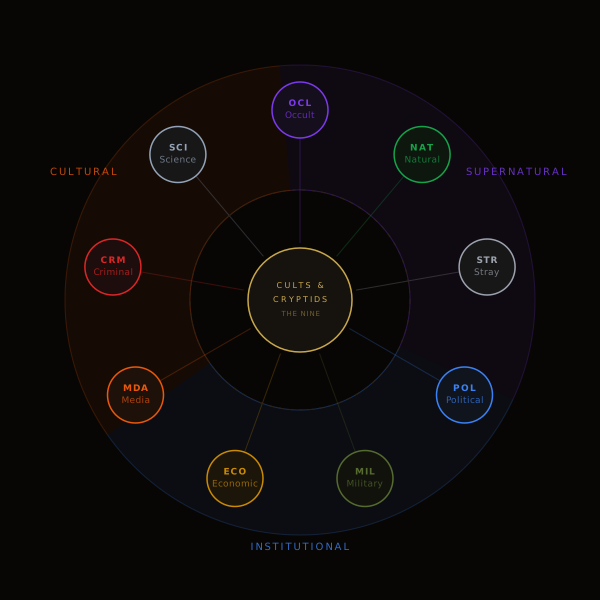
The nine factions are not random — they form a deliberate trifecta of three schools of power, each containing three expressions of that power.
Ancient forces, folk wisdom, and the unaffiliated. Madness-heavy, Cryptid-dense, long game. Compatible types overlap — they summon together seamlessly.
Power structures, hierarchy, and organized control. Faith manipulation, board control, resource denial. They trade followers and rituals fluidly.
Narrative, aggression, and knowledge as weapons. Criminal hits early, Media amplifies over time, Science controls what sticks. Volatile but explosive.
Cross-Tier Archetypes
The most natural multi-faction decks pull from within a tier. Cross-tier combinations are the spicy builds — deliberate choices rather than obvious pairings:
- Criminal / Occult — The classic dark cult. Street muscle summons folklore monsters.
- Military / Science — The black ops program. Classified assets and documented phenomena.
- Media / Political — The propaganda machine. Signal damage amplified by institutional reach.
- Occult / Political — The shadow theocracy. Ancient power meets modern leverage.
- Natural / Economic — The resource cult. Wilderness pressure funded by financial manipulation.
All Nine Factions
Resurrection
Some cards reference Resurrection — returning a destroyed card from the Waste pile to play.
- Resurrected cards enter play immediately.
- They enter exhausted — they cannot attack the turn they're resurrected.
- Resurrection ignores normal play costs.
- Cards with Cannot be Resurrected go to the Waste when destroyed as normal — they simply cannot be returned to play by any Resurrection effect.
Madness Economy
Understanding Madness flow is the key to mid and late game power.
- 1 Madness per attack that lands — on any target, regardless of damage.
- 1 Madness per direct Influence hit — every time your Influence takes damage.
- Card effects — many cards generate bonus Madness on play or per turn.
- The player taking more hits accumulates Madness faster, giving the defending player a catch-up mechanism.
Unaffiliated Cards
The Unaffiliated faction represents people, ideas, and entities that belong to no institution. Wanderers, burnouts, paranoid believers, universal prayers.
- Unaffiliated cards can be included in any deck, without counting toward the 3-faction limit.
- Unaffiliated Cryptids use the compatible types listed on the card — typically requiring Occult, Natural, or Science followers.
- Cards like Prayer exist in all faction variants — play the version that matches your cult for thematic consistency.